Version 2.0.10Tue Nov 28 2023
Bug fixes and other minor updates.
History of Wheel Games
Fate, fortunes and misfortunes, were determined by gaming wheels going back probably over two thousand years. Wheel of Fortune or Rota Fortunae was an early symbol of fate. Roman Legion soldiers turned over their chariots and bet on the outcomes of spinning their wheels. Early wheels were paddle wheels and it wasn’t until the late 17th or early 18th century that Roulette (“little wheel”) was introduced. While Roulette did take off across casinos in Europe and the Americas, paddle wheels continue to be played in some casinos.
Value of Paddle Wheel Games
Paddle wheels display their spin vertically so players can easily observe their selected wagers revolving increasingly slower as the wheel decelerates. Watching their fate as it slowly rises as a possible winner only to have it click, click ..... click – Darn – almost! Our wheels move players who often begin to stand as their luck seems likely – and then, if it passes, they throw themselves into the chair with disappointment. Other games do not provide that level of anticipation, expectation and then........ah, shucks or YES! Keno merely flashes numbers. Dice are very fast. With cards, while they do have some anticipation as they associate with other cards in a pattern, they do not quite deliver the same level of catharsis.
This Edition of Tri-Wheel®
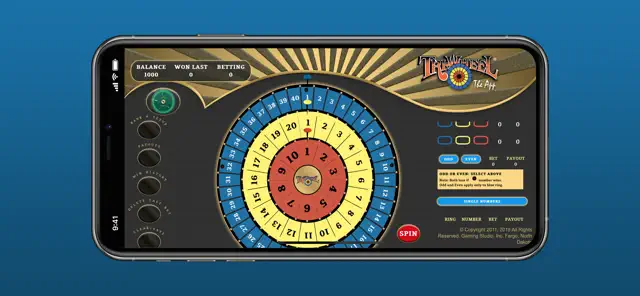
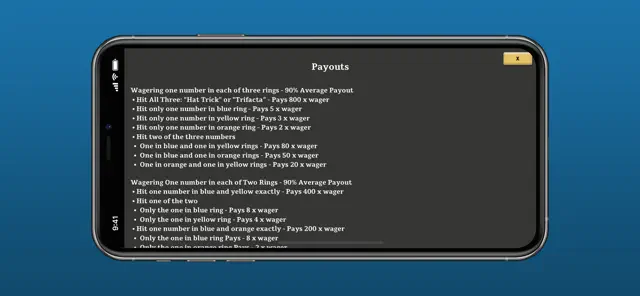
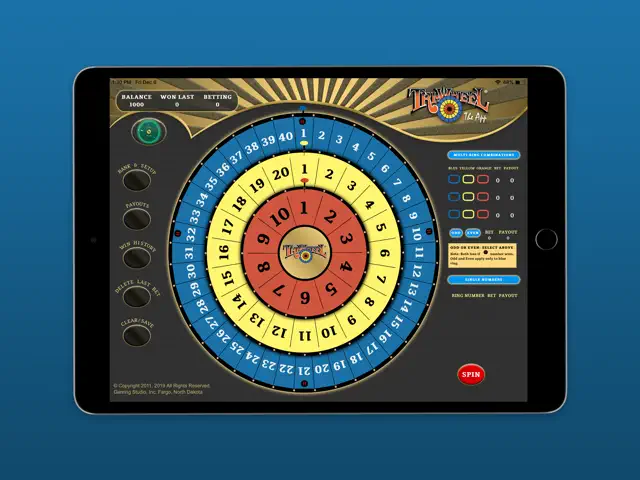
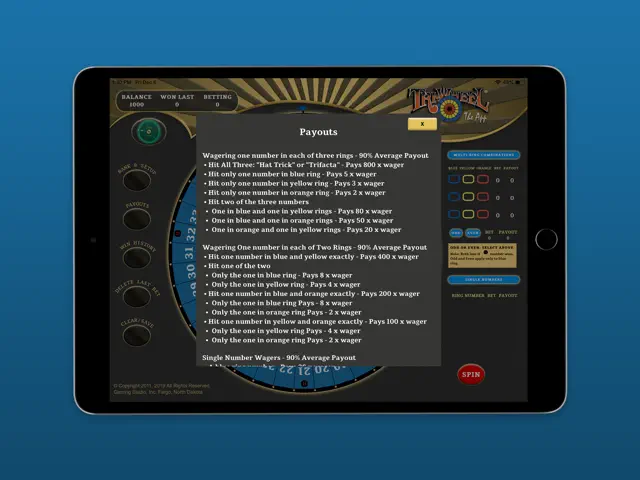
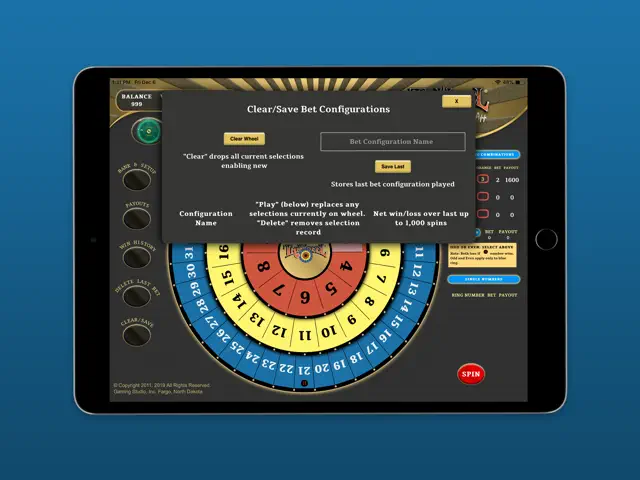
Tri-Wheel is an electronic paddle wheel game similar to that legally wagered in Minnesota since 1987 with a few exceptions. This electronic edition is configured for a 90% payout. Each of the three rings have independent randomization allowing a player
with the multi-ring combination to select a number in each of at least two of the rings and should they both hit in one coordinated spin, the payout is higher than one finds on the mechanical edition where the rings are not independently spun. The numbers on this wheel are arrayed sequentially to allow for better tracking of your wagers. For “odd” and “even” wagers (applying only to the blue ring) we have four red “H” (meaning “house”) designated numbers upon which both odd and even lose.
This amusement edition of the Tri-Wheel provides some notion of what an electronic wheel game might be like. Wagering would be on a touch-sensitive multi-player table using virtual chips or through a lotto like slip that registers all of the wagers a player might wish to make for each spin.
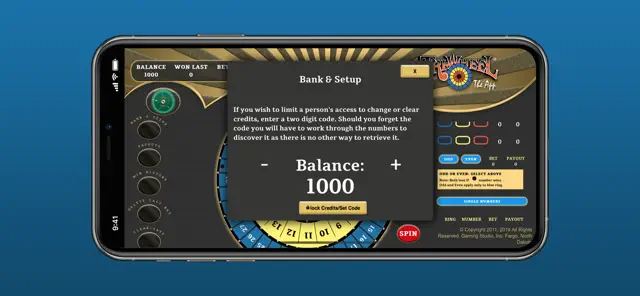
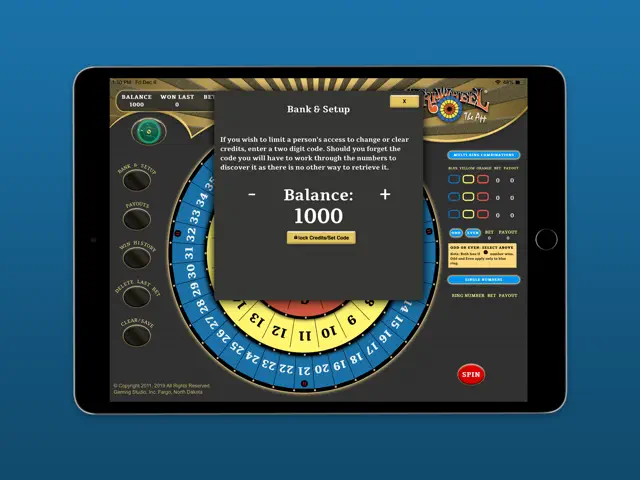
As a player may bank up as many credits or units as you wish in the Bank & Setup area. You can use a two-digit, hence not too secure, code as an impediment to changing the balance in the bank. Thus, you can have a little competition with others to see who lasts the longest or finishes with the most credits in a given period of time.
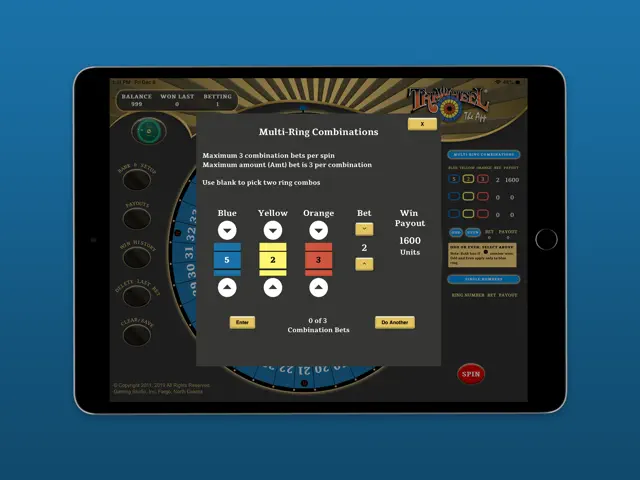
Wagering on multi-ring combinations is accomplished by first touching the “multi-ring combination” bar and then dialing up or down to the number in each ring – a blank means you are not betting that particular ring.
Wagering on exact numbers requires that you touch the “single numbers” bar and then tap the different numbers on the wheel that you wish to bet. The more you tap on a number the more units wagered.
Wagering on “Odd” or “Even” can be done by tapping either the “Odd” or “Even” as many times as the units you wish to wager. Remember that “Odd” and “Even” applies only to the blue ring of the wheel and both lose if one of the dreaded “H” designated numbers is indicated as winning.
In selecting your numbers, the “win history” shows a wheel diagram for each ring with the quantity of hits and the percentage for each segment of the wheel.
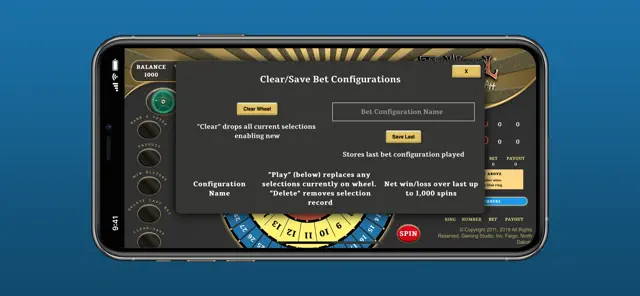
Aiding in your development of wagering strategies you may create up to 10 multi- wager bet configurations and check how well those configurations perform over the past up to 1,000 spins.
More information is available at: http://www.wheelgames.app and http://www.triwheel.com
Tri-Wheel® is a registered trademark and trade dress owned by Gaming Studio, Inc., Fargo, North Dakota.
Requires iOS 11.0 or later. Compatible with iPhone, iPad, and iPod touch.
History of Wheel Games
Fate, fortunes and misfortunes, were determined by gaming wheels going back probably over two thousand years. Wheel of Fortune or Rota Fortunae was an early symbol of fate. Roman Legion soldiers turned over their chariots and bet on the outcomes of spinning their wheels. Early wheels were paddle wheels and it wasn’t until the late 17th or early 18th century that Roulette (“little wheel”) was introduced. While Roulette did take off across casinos in Europe and the Americas, paddle wheels continue to be played in some casinos.
Value of Paddle Wheel Games
Paddle wheels display their spin vertically so players can easily observe their selected wagers revolving increasingly slower as the wheel decelerates. Watching their fate as it slowly rises as a possible winner only to have it click, click ..... click – Darn – almost! Our wheels move players who often begin to stand as their luck seems likely – and then, if it passes, they throw themselves into the chair with disappointment. Other games do not provide that level of anticipation, expectation and then........ah, shucks or YES! Keno merely flashes numbers. Dice are very fast. With cards, while they do have some anticipation as they associate with other cards in a pattern, they do not quite deliver the same level of catharsis.
This Edition of Tri-Wheel®
Tri-Wheel is an electronic paddle wheel game similar to that legally wagered in Minnesota since 1987 with a few exceptions. This electronic edition is configured for a 90% payout. Each of the three rings have independent randomization allowing a player
with the multi-ring combination to select a number in each of at least two of the rings and should they both hit in one coordinated spin, the payout is higher than one finds on the mechanical edition where the rings are not independently spun. The numbers on this wheel are arrayed sequentially to allow for better tracking of your wagers. For “odd” and “even” wagers (applying only to the blue ring) we have four red “H” (meaning “house”) designated numbers upon which both odd and even lose.
This amusement edition of the Tri-Wheel provides some notion of what an electronic wheel game might be like. Wagering would be on a touch-sensitive multi-player table using virtual chips or through a lotto like slip that registers all of the wagers a player might wish to make for each spin.
As a player may bank up as many credits or units as you wish in the Bank & Setup area. You can use a two-digit, hence not too secure, code as an impediment to changing the balance in the bank. Thus, you can have a little competition with others to see who lasts the longest or finishes with the most credits in a given period of time.
Wagering on multi-ring combinations is accomplished by first touching the “multi-ring combination” bar and then dialing up or down to the number in each ring – a blank means you are not betting that particular ring.
Wagering on exact numbers requires that you touch the “single numbers” bar and then tap the different numbers on the wheel that you wish to bet. The more you tap on a number the more units wagered.
Wagering on “Odd” or “Even” can be done by tapping either the “Odd” or “Even” as many times as the units you wish to wager. Remember that “Odd” and “Even” applies only to the blue ring of the wheel and both lose if one of the dreaded “H” designated numbers is indicated as winning.
In selecting your numbers, the “win history” shows a wheel diagram for each ring with the quantity of hits and the percentage for each segment of the wheel.
Aiding in your development of wagering strategies you may create up to 10 multi- wager bet configurations and check how well those configurations perform over the past up to 1,000 spins.
More information is available at: http://www.wheelgames.app and http://www.triwheel.com
Tri-Wheel® is a registered trademark and trade dress owned by Gaming Studio, Inc., Fargo, North Dakota.