★★★★★ Great graphics, relaxing gameplay
Sat Aug 20 2022 fatstuffaliciousUPDATE ***
Love the new spider solitaire update! Similar to Churchill solitaire but without the alternating suits. It’s great to be able to switch back and forth between spider and traditional, and super nice that they made it a little easier to get to the game play settings! I absolutely love the newest theme, it’s sunny and looks hand drawn, just what I needed. I hope they continue to focus on the artwork, and pretty pls moar prize ball items! ❤️❤️❤️
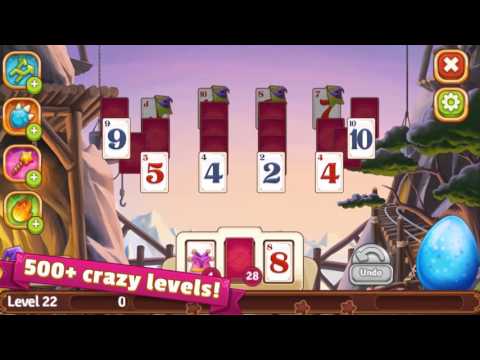
I love this solitaire game. You can play either a single game or a series of games in a “story” that gets progressively harder. My original complaint was that there weren’t enough stories, and they added more stories! Albeit with some odd choices for celebrity voice actors (Jane lynch was a great choice, but the writing was kinda blah). Honestly I don’t really care about celebrities, I just want more stories to get through AND more items to “win” from the ball machine thing (when you get the game this will make sense). I’ve acquired all of them, and I’d love more, or the option to create my own somehow. And please, just spend the money to pay developers to make more stories. Preferably with animals. It’s a great solitaire game, good graphics and sounds. Would just be nice to have more. We are still in a pandemic and this is one of several apps I use to escape from the anxiety and stress of the dumpster fire that is our world.
★★★★★ Update:
Fri Dec 22 2023 kpncThe game creators responding quickly to my first review , and I’m happy to report some great improvements to the game. The game note will automatically change to landscape view when I turn my phone, which makes it easier to read the cards. While some fonts are still difficult for me to read, there are many more with colors and fonts that I am able to read easily. The deck in the current “Light the Candles” game is beautiful -I hope it remains available after the special event is complete. The changes in the past few months have moved this game into first place in my Solitaire games.
This could be a great solitaire game except for the font size and style. I play solitaire to reduce stress, but the font is too small, and it can’t be zoomed in to increase the size. The style of the font increases the problem of readability. There is a choice of style for different colors and graphics on card fronts and backs, but no large print option. Instead of making large numbers or showing the numbers by having the numbers suit symbols on the card face, they have one large suit symbol on each card. Why not have an option to have the number large and the suit small?
★★★★★ Latest update fixed my gripes!
Fri Aug 13 2021 LordSmapyEdit: My major complaint originally was that the Apple Pencil didn’t work at all. I’m glad to see that the fixed it and it works very well. I’m finally getting into the game and I’m enjoying it so far. I’ll probably update with a more detailed review once I get further in.
Normally I write really long detailed reviews, but I’m so frustrated this time I don’t really want too. I have a newer iPad Pro with the version 2 Apple Pencil which I use for lots of my apps. This app doesn’t support the Apple Pencil. At all. It literally has no response to any tapping, dragging, or anything. I find myself opening up the game, pencil in hand and wonder why it’s not working after several taps, thinking it’s dead, only to remember this is my only app to not support it. I have played it, but I have other solitaire games that work with the pencil and are still solitaire. I admit I don’t see myself playing this one until the pencil works. I don’t normally write harsh reviews, but Im confused on why a card game doesn’t support the pencil. The graphics are nice and so is the gameplay, so I’ll keep it installed in the hopes it updates with pencil support and I’ll re-review it.
★★★★★ Great game! Small issue.
Sun Aug 15 2021 EVO WI really enjoy this app! I’ve played solitaire before, but not a ton. I hated dealing with ads after each game on other solitaire apps and playing with real cards wasn’t convenient . However, playing with this game was much more fun! I enjoy all the different styles of cards and stories to go along with them. In addition, I enjoyed having different difficulties of games to make it more interesting or challenging. The music, sound effects, and animations are all great, and make this game super addicting! I only have one problem with the app, and that’s with the hints. They work fine most of the time, but I’ve noticed that when the game wants you to pull down a card that you’ve already stacked with your aces, it shows that as pulling down a new card from the deal. This can be confusing if the hints are telling you to pull down a new card, but none of them will stack. All in all, it’s a really fun game and I would love to see more content added!
★★★★★ Still laggy after post-iOS 15 update
Thu Sep 30 2021 athleticsfanThis was a pretty good game. The stories are corny, but I liked the variety that each theme brought with it. Then came iOS 15, which made for a very laggy experience that’s unresponsive to multiple taps. When it does respond, it gives you multiple cards, depending on how many times you tapped trying to get it to behave. I just installed the latest update, which was supposed to address the lag and responsiveness issues, but there’s still more work to do. It initially seemed more responsive, but I still have to tap multiple times to draw new cards, especially. It seems like there’s a sweet spot on the draw pile, where it’ll react normally. Otherwise, it’ll take multiple tries. The only positive is that it no longer gives you multiple cards when it finally catches up. Now, i recognize that iOS 15 is a bit of a trash fire right now, and I’m seeing lagging performance all throughout the OS, so I don’t want to place all the responsibility on the dev (hence the 3 stars), but anything they can do to get back to pre-iOS 15 performance would be greatly appreciated.
★★★★★ Solitaire Stories
Thu Jul 15 2021 tjgavlickIt’s solid solitaire, with satisfying animations and sound design (save for some of the more … grating background loops). Everything feels pretty good to interact with. It’s not buggy. Can’t complain too much, and I’ve put a good bit of time into it. Only thing I’m knocking the rating for is the hints could use some work (e.g. might be nice to know when something becomes impossible to solve).
The inevitable “however” bit, I think, comes from my own expectations going into the thing. When I saw the Solitaire Stories title, I imagined a bunch of creative alternate rules to match a story beat, or maybe some tailored minimalist scenarios to puzzle out based on character actions, or a gradual introduction to advanced techniques (if there exist such a thing), and so on. Unfortunately, all of the stories amount to “this thing happened. Now go play two games of solitaire to see the next thing.” Repeat. It would be unfair to ding the overall rating based on something I cooked up in my head, but it does feel like it could really be cool someday.
★★★★★ It seems like something is wrong…
Mon Feb 06 2023 FogdorI do pretty good with solitaire, but the frequency in which I fail to clear the deck in this version seems abnormally high. I have a different solitaire game that lets me play “winning hands” only. And I clear about 70% of those without getting stuck on the first try. I’d have to tabulate but in this game I think I’m at a point where I am only clearing about 15%. This doesn’t fit with the fact that 90% of true random shuffled deals should be winnable. This also keeps me from retrying hands because I don’t have any incentive to try again because it there isn’t a clear way to tell if it’s not a winnable hand. I’m not sure if the game try’s to give you harder hands the more you play, but it seems like you are doing something that makes it less winnable that a real deck of cards so I keep going back to the other version. The cads and game story are beautiful, but there is just something about the play that discourages me from coming back.
Lately, even worse is the crashes on competitive play (at least with spider). Fix it please.
★★★★★ Story mode is fine. Quick play is impossible.
Thu Feb 24 2022 Supe321Let’s start off with the good. The stories and the animations are very nice. There are also a lot of unlockables, which you can get just by playing.
Now the main issue I have is with quick play. I’m not sure if I just won too many games and it ramped up the difficulty or what. I often lose several times in a row and it is often caused by ONE wrong move. You can literally know that you goofed up by flipping over the wrong card. You literally can’t recover and no, I don’t want to press “undo” 20 times to go and choose the other “correct” column. Please fix this. I’m not sure why quick play has to be that difficult. There is no way to set the difficulty on quick play and most of your coins will come from quick play. Yes, I want to open the game and earn my coins for unlockables but honestly, I try to avoid opening this app and more than likely, when my Apple Arcade runs out I won’t be renewing. Devs, please don’t respond by saying that I can change the difficulty of the story mode because that’s not what’s causing the frustration.